Geneva has a reputation as a city of banks, watches and diplomats, and the lakefront looks the part. Behind it is a city that took in refugees for four centuries, gave the world the Red Cross and the rules of war, hosted the first great international arbitration of the modern age, and was where the World Wide Web began.
What follows is Geneva's bright side, in roughly the order it happened. Some of its famous stories are true, and a few are legends the city is fond of; we say which is which. Every chapter ends with something you can go and see.
1541–1560: The City of Refuge
In 1541 the French reformer John Calvin returned to Geneva for good, and the small city became the capital of the Reformed faith. Persecuted Protestants from France, Italy, England and the Low Countries came here for safety. Between 1549 and 1587 about 8,000 refugees were granted residence, and about 3,000 stayed for good, roughly a third of the city's population. Printers among them made Geneva a centre for Bibles and books.
One of those books was the Geneva Bible, made by English Protestant exiles. Its New Testament appeared in 1557 and the full Bible in 1560. It was the first complete English Bible translated from the original Hebrew and Greek, and the first printed in plain Roman type with numbered verses, which made it easy to read. It was the Bible Shakespeare quoted, and the one the Pilgrims carried on the Mayflower.
In 1559 Calvin founded the Academy of Geneva, which became the University of Geneva. Its first rector was Theodore Beza.
After 1685, when Louis XIV revoked the Edict of Nantes and outlawed Protestantism in France, a second wave came. Tens of thousands of Huguenots passed through Geneva; the city could not house them all and sent most on to Vaud and Germany, but a few thousand stayed. So many came that Geneva had to build a new church for them: the Temple de la Fusterie, designed by a refugee architect and finished in 1715.
 The title page of the Geneva Bible of 1560. Image: , Public domain, via Wikimedia Commons.
Where to see it today:
- The Reformation Wall in the Parc des Bastions, built between 1909 and 1917: a 100-metre stone wall with five-metre statues of Farel, Calvin, Beza and John Knox, and the city's motto, Post Tenebras Lux, "after darkness, light".
- The Temple de la Fusterie, on Place de la Fusterie, near the lake.
 The Reformation Wall in the Parc des Bastions. Image: Jean-Pierre Dalbéra from Paris, France, CC BY 2.0, via Wikimedia Commons.
The 17th Century: Watches
Geneva's watchmaking is often said to have started with Calvin. His laws restricted jewellery and display, so the city's goldsmiths turned to making watches, which counted as useful instruments. That is part of the story. The other part is the refugees: French and Italian craftsmen brought their skills, and by 1601 the watchmakers had their own guild. By 1700 there were so many in Geneva that many moved out to the valleys of the Jura, where the Swiss watch industry grew.
In 1886 the canton created the Geneva Seal, a mark guaranteeing that a watch was made and finished in Geneva to the highest standard. It still exists.
 A Patek Philippe pendant watch made in Geneva in 1888. Image: Daderot, Public domain, via Wikimedia Commons.
Where to see it today: the Patek Philippe Museum, rue des Vieux-Grenadiers 7, in the Plainpalais district, with five centuries of watches and automata. It is closed on Mondays.
1602: The Escalade and the Pot of Soup
On the night of 11 to 12 December 1602, troops of the Duke of Savoy tried to take Geneva by surprise, climbing the city walls with ladders. The citizens woke, fought in the streets and drove them out. Eighteen Genevans died. A peace treaty the next year secured the city's independence.
The best-known hero of that night is Mère Royaume, a woman who is said to have poured a cauldron of hot soup from her window onto the attackers and then hit one with the pot. She was a real person, Catherine Cheynel, the wife of the mint's engraver, and she lived above one of the city gates. The soup story itself appears only later and is a legend. Genevans tell it anyway.
Every December Geneva celebrates the Escalade: a costumed procession through the old town, a race through the streets, and chocolate marmites, pots filled with marzipan vegetables. The eldest and youngest people at the table smash the pot together, saying "Thus perish the enemies of the Republic!"
 A chocolate Escalade marmite. Image: Clément Bucco-Lechat, CC BY-SA 3.0, via Wikimedia Commons.
Where to see it today:
- The Escalade fountain on rue de la Cité in the old town, from 1857, with the names of the Genevans who died.
- The Escalade weekend in mid-December, with the procession on the Sunday.
 The figure of Geneva on the Escalade fountain, rue de la Cité. Image: MHM55, CC BY-SA 4.0, via Wikimedia Commons.
1712: Rousseau, Citizen of Geneva
Jean-Jacques Rousseau was born at Grand-Rue 40 on 28 June 1712. He left the city at 15, when he came back late from a walk and found the gates locked. His ideas on freedom, education and the social contract shaped the French Revolution and modern democracy. Even when he quarrelled with the city, he signed his books "Citizen of Geneva".
Where to see it today:
- The Maison de Rousseau et de la Littérature, Grand-Rue 40, the house where he was born, with an audiovisual tour of his life.
- The Île Rousseau, a small island where the Rhône leaves the lake, with a bronze statue of him from 1835.
1816: The Night Frankenstein Was Born
In the summer of 1816 the poet Lord Byron rented the Villa Diodati in Cologny, on the hill above the lake. That year a volcanic eruption in Indonesia had filled the sky with ash, and Europe had a "year without a summer". Stuck indoors by the rain, Byron challenged his guests to write ghost stories. One of them was Mary Shelley, 18 years old. Her story became Frankenstein, published in 1818. Byron's doctor, John Polidori, wrote The Vampyre the same summer.
 The Villa Diodati at Cologny. Image: Robertgrassi, Public domain, via Wikimedia Commons.
Where to see it today: the villa is private and can only be seen from outside, from a public path nearby. In the city, a statue of Frankenstein's creature stands on the Plaine de Plainpalais, where the monster commits its first murder in the novel.
1863–1864: The Red Cross and the Geneva Convention
In June 1859 a Geneva businessman, Henry Dunant, travelled to northern Italy hoping to see Napoleon III about his business in Algeria. He arrived in the town of Castiglione the evening after the Battle of Solferino, where about 40,000 men had been killed or wounded in a single day. Thousands lay without care. Dunant organised the local women and volunteers to look after the wounded of both armies alike.
In 1862 he published A Memory of Solferino, at his own expense, asking why every country could not train volunteers in peacetime to care for the war-wounded, and agree to protect them. In February 1863, five Genevans, Dunant, Gustave Moynier, General Guillaume-Henri Dufour, Louis Appia and Théodore Maunoir, formed a committee that became the International Committee of the Red Cross.
On 22 August 1864, delegates of 16 states met in Geneva's town hall and signed the first Geneva Convention: wounded soldiers and the people who cared for them would be protected, whatever side they were on. Its successors, the four Geneva Conventions of 1949, have been ratified by every state in the world.
Dunant himself went bankrupt in 1867, left Geneva and lived in poverty for years. In 1901 he received the first Nobel Peace Prize. He never spent the prize money.
 Henry Dunant in later life. Image: , CC BY 4.0, via Wikimedia Commons.
Where to see it today:
- The International Red Cross and Red Crescent Museum, Avenue de la Paix 17, opposite the Palais des Nations. It is closed on Mondays.
- The bust of Dunant on Place Neuve, at the foot of the old town.
- The Hôtel de Ville in the old town, where the convention was signed.
 The bust of Henry Dunant on Place Neuve. Image: RomanDeckert, CC BY-SA 4.0, via Wikimedia Commons.
1872: Settling a War Without a War
During the American Civil War, British shipyards had built warships for the Confederacy. The most famous, the CSS Alabama, sank or captured dozens of Union merchant ships. After the war the United States demanded compensation, and relations with Britain were bitter.
Instead of fighting, the two countries agreed to let an international tribunal decide. Five arbitrators, from the US, Britain, Italy, Switzerland and Brazil, met in the same room of the Geneva town hall where the convention had been signed. On 14 September 1872 they awarded the United States 15.5 million dollars, and Britain paid. It was not the first arbitration in history, but it is widely seen as the birth of modern international arbitration, and the room has been called the Alabama Room ever since.
 The Geneva tribunal settling the Alabama claims in 1872, from a contemporary engraving. Image: Internet Archive Book Images, No restrictions, via Wikimedia Commons.
Where to see it today: the Hôtel de Ville, rue de l'Hôtel-de-Ville 2. Look for the bronze Alabama plaque on the building. The Alabama Room is a working room of the cantonal government and opens only on occasional open days; there is a virtual tour on the canton's website.
 The Alabama plaque at Geneva's Hôtel de Ville. Image: Traumrune, CC BY-SA 3.0, via Wikimedia Commons.
1886: A Fountain Born From a Safety Valve
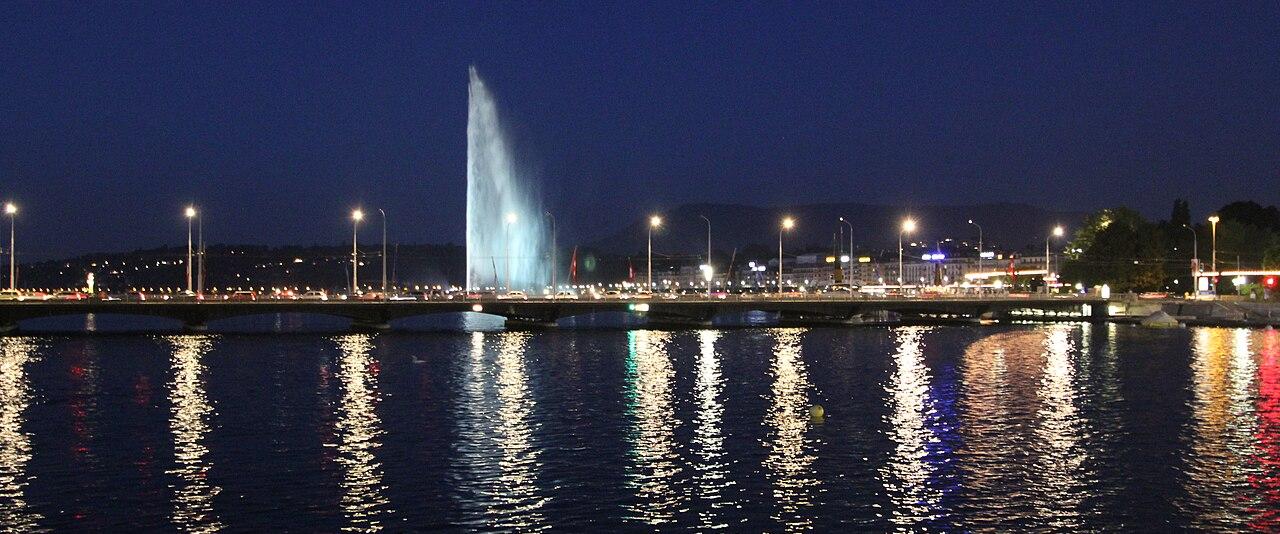
Geneva's symbol, the Jet d'Eau, began as a piece of plumbing. In 1886 the city's new hydraulic plant, which supplied water power to workshops, needed a valve to release excess pressure at the end of the working day. It shot a jet of water about 30 metres into the air. People liked it so much that in 1891 it was moved to the lake as a fountain. The current jet, with its own pumps, dates from 1951. It throws 500 litres of water a second 140 metres into the air.
On many evenings it is lit in different colours for international days and causes.
 The Jet d'Eau and the moon rising over Mont Blanc. Image: lilo9948, CC BY-SA 4.0, via Wikimedia Commons.
Where to see it today: the Jet d'Eau on the Eaux-Vives jetty. In summer it runs until late evening, lit; in winter, by day only, and it is switched off for maintenance for a few weeks each year (in 2026, from 2 November to 3 December).
1920 and After: The International City
After the First World War, Geneva was chosen as the seat of the League of Nations. Its first Assembly opened on 15 November 1920. The League failed to prevent the next war, but some of its work lasted. In 1922 its High Commissioner for Refugees, the Norwegian explorer Fridtjof Nansen, created the Nansen passport, an identity document for stateless refugees. About 450,000 were issued, and Nansen won the Nobel Peace Prize for his work.
 A Nansen passport issued in 1929. Image: Huddyhuddy, CC0, via Wikimedia Commons.
The League's palace became the European home of the United Nations in 1946. The World Health Organization was founded in 1948 with its headquarters in Geneva, and today the city hosts dozens of international organisations and hundreds of non-governmental ones.
 The flags of the member states outside the Palais des Nations. Image: Benoît Prieur, CC0, via Wikimedia Commons.
In front of the palace stands the Broken Chair, a 12-metre wooden chair with one leg shattered. It was built in 1997 for Handicap International, as a protest against landmines and cluster bombs, and was meant to stay for three months, until the treaty banning landmines was signed. It is still there.
 The Broken Chair on the Place des Nations. Image: Ank Kumar, CC BY-SA 4.0, via Wikimedia Commons.
Where to see it today: the Palais des Nations. Guided tours must be booked online; bring ID and arrive early for security. The Broken Chair stands on the Place des Nations opposite.
 The headquarters of the World Health Organization in Geneva. Image: Thorkild Tylleskar, CC BY-SA 3.0, via Wikimedia Commons.
1960: Votes for Women
On 6 March 1960 the men of Geneva voted to give women the vote in cantonal elections. It was only the third Swiss canton to do so, after Vaud and Neuchâtel the year before, and more than a decade before Switzerland as a whole, in 1971.
1988: Saving the Baths
The Bains des Pâquis, public baths on a jetty in the lake, have been here since 1872 and were rebuilt in 1932. In the 1980s the city planned to demolish them and build new ones. The people who swam there formed an association and forced a referendum. In 1988, 72 per cent voted to keep the old baths. They were restored instead, between 1992 and 1995.
 The Bains des Pâquis in the evening. Image: Babsy, CC BY-SA 4.0, via Wikimedia Commons.
Where to see it today: the Bains des Pâquis, Quai du Mont-Blanc 30. In summer you can swim in the lake; in winter there is a sauna and hammam, and fondue at the buvette.
1989–1991: The Web
The European Organization for Nuclear Research, CERN, was founded in 1954 on the edge of Geneva. In March 1989 a British scientist working there, Tim Berners-Lee, wrote a proposal for a system to share documents between the lab's computers using links. With his colleague Robert Cailliau he built the first web server, browser and pages by the end of 1990, and in August 1991 the World Wide Web was opened to the whole internet. On 30 April 1993 CERN released the technology to the world free of charge, with no patents and no royalties.
 The NeXT computer at CERN that served as the world's first web server. Image: Rama, CC BY-SA 2.0 fr, via Wikimedia Commons.
Where to see it today: CERN Science Gateway, at the CERN site at Meyrin, opened in 2023, with free exhibitions on physics and the lab's history. It is open Tuesday to Sunday; entry is free, but book ahead.
How to See Bright Geneva
A self-guided walk, about 4 km. Start at the Jet d'Eau, walk along the lake to the Île Rousseau, cross into the old town to the Temple de la Fusterie, then climb to Rousseau's birthplace on the Grand-Rue and the Hôtel de Ville with its Alabama plaque. Pass the Escalade fountain, then come down to Place Neuve for Dunant's bust and finish at the Reformation Wall in the Parc des Bastions.
Further afield:
- The Palais des Nations, the Broken Chair and the Red Cross Museum, on the right bank.
- The Bains des Pâquis for a swim or a fondue.
- CERN Science Gateway at Meyrin, by tram.
- The Patek Philippe Museum in Plainpalais.
- The Villa Diodati at Cologny, from outside.
Dates to know:
- 22 August: the anniversary of the first Geneva Convention, 1864.
- Mid-December: the Escalade.
- 8 May: World Red Cross and Red Crescent Day, Henry Dunant's birthday.