Zurich has a reputation as Europe's most orderly city: clean trams, a lake you can swim in, banks on Bahnhofstrasse and chocolate on every corner. Its history is less tidy. It burned its Jews in 1349, beheaded its own mayor, drowned religious dissenters in the river and burned women as witches. Its bankers took looted gold from Nazi Germany, its most famous art collection was built on wartime arms sales, and as recently as the early 1990s thousands of heroin users gathered in a park behind the main station.
Most of these chapters left something behind you can still find: a plaque on the river wall, medieval paintings in a Jewish family's house, a statue of a mayor the city executed. This guide goes through them in order, from 1349 to the present, and tells you where to see each one.
1349: The Burning of the Jews
When the Black Death swept across Europe in 1348–49, rumours spread that Jews were poisoning the wells. In Zurich, in February 1349, the city's Jews were rounded up and burned to death, reportedly locked inside a house; dozens were killed and the survivors expelled. Jews returned to the city within a few years, but were finally expelled in 1624.
The medieval Jewish quarter lay around today's Froschaugasse, then called Judengasse. In 1996 builders renovating a house on Brunngasse found wall paintings from about 1330, made for a Jewish family named Minne: coats of arms and scenes of medieval life. Members of the family were probably among those killed in 1349.
 The wall paintings of about 1330 in the house of the Minne family at Brunngasse 8. Image: Albinfo, CC0, via Wikimedia Commons.
Where to see it today: the paintings can be seen at Schauplatz Brunngasse, Brunngasse 8, open Tuesday to Friday from 14:00 to 18:00, free. Around the corner, a plaque at Froschaugasse 4 marks the site of the medieval synagogue.
1489: The Mayor on the Block
Hans Waldmann was the most powerful man in late-15th-century Zurich, a soldier who had won fame against Burgundy and become mayor. His enemies accused him of corruption, abuse of power and sodomy, and in April 1489 a revolt toppled him. He was beheaded on 6 April 1489.
 The execution of Hans Waldmann in 1489, from Diebold Schilling's Lucerne Chronicle (1513). Image: Diebold Schilling, Public domain, via Wikimedia Commons.
Where to see it today: an equestrian statue of Waldmann by Hermann Haller stands on the Münsterhof, in front of the Fraumünster. It was unveiled on the anniversary of his execution in 1937, after a campaign by the city's guilds to restore his name, and it is still argued over.
1487–1701: The Witch Trials
Between 1487 and 1701 Zurich executed between 80 and 85 people for witchcraft, almost all of them women. They were burned on a gravel bank of the Sihl river, in later years usually after being beheaded; those accused of lesser forms of magic were drowned in the Limmat. The last trial, in 1701, concerned seven women and a man from the village of Wasterkingen; all eight were executed.
 A punishment scene from the Wickiana, the 16th-century chronicle collection compiled in Zurich. Image: de:Johann Jakob Wick, Public domain, via Wikimedia Commons.
Where to see it today: there is no memorial. Zurich's city parliament voted for one in 2014, but it has not been built. In 2001 the Reformed Church of the canton formally condemned the role its pastors had played.
1524–1531: The Reformation
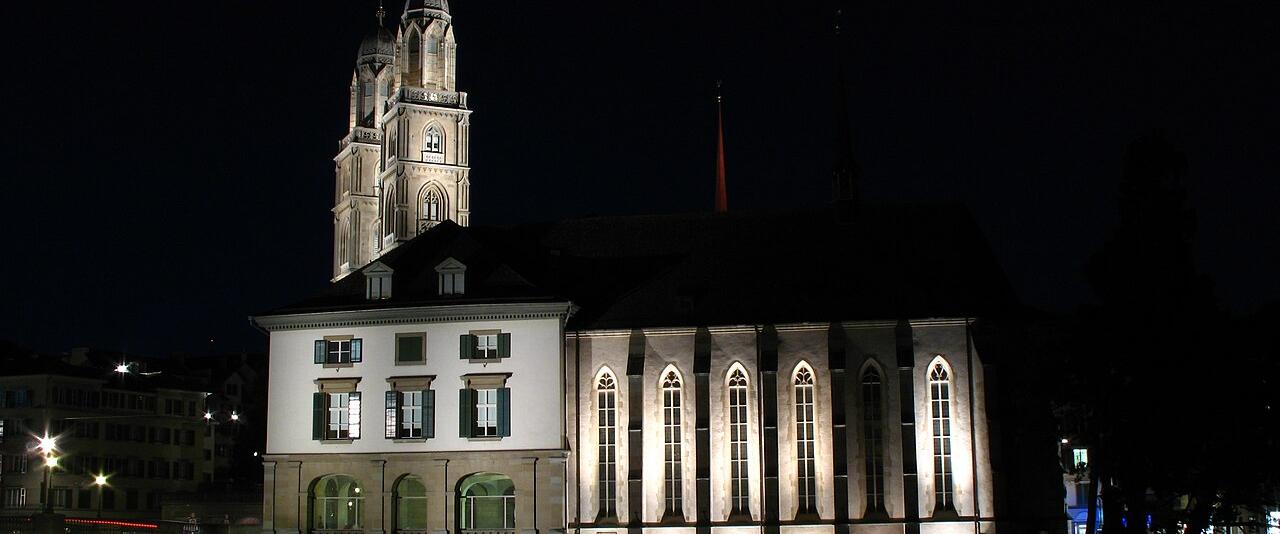
Zurich was the first Swiss city to break with Rome, under the preacher Ulrich Zwingli of the Grossmünster. In June 1524 the city council ordered the images removed from its churches. Paintings and statues were taken down, smashed or burned, the walls were whitewashed, and the Grossmünster's organ was later broken up.
The Reformation had its own victims. A group of Zwingli's former followers, the Anabaptists, refused to baptise their children, and in March 1526 the council made rebaptism punishable by drowning. On 5 January 1527 Felix Manz was taken by boat into the middle of the Limmat, his hands tied behind his knees, and thrown into the river. Five more Anabaptists were drowned there in the next five years. The last Anabaptist executed in Zurich, Hans Landis, was beheaded in 1614.
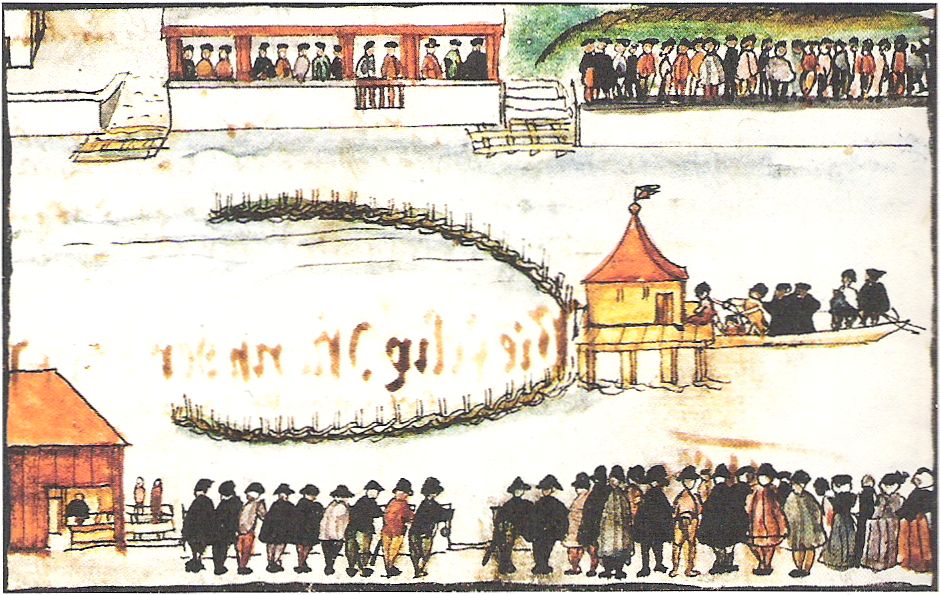 The drowning of Felix Manz in the Limmat in 1527, painted about 1605. Image: Heinrich Thomann, Public domain, via Wikimedia Commons.
Zwingli himself died in battle. In October 1531 Zurich fought the Catholic cantons at Kappel, and Zwingli, who had gone with the army, was killed. His body was quartered and burned, and his ashes were scattered.
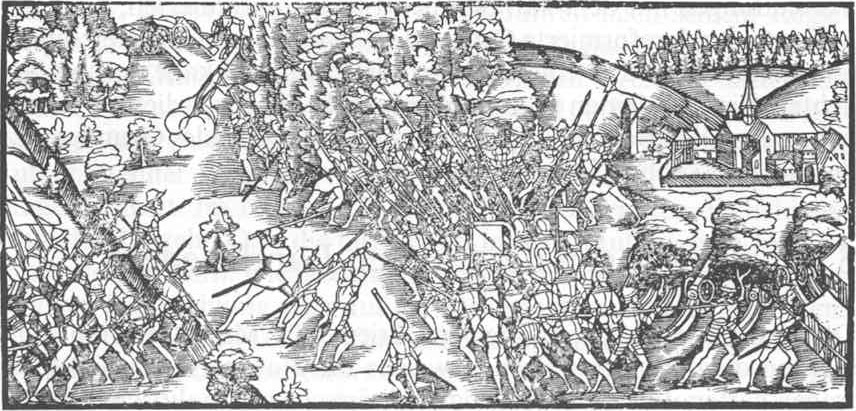 The Battle of Kappel, 1531, in a woodcut from 1548. Image: Johannes Stumpf, Hans Asper, Public domain, via Wikimedia Commons.
Where to see it today:
- A plaque set into the river wall opposite Schipfe 43, unveiled in 2004, marks where Manz and the other Anabaptists were drowned. The city had refused one in 1952.
- Zwingli's statue, from 1885, stands beside the Wasserkirche on the Limmatquai.
- The bare interior of the Grossmünster.
- A memorial stone at Kappel am Albis, about 20 kilometres south of the city, marks where Zwingli fell.
 The plaque on the Limmat river wall at the Schipfe where Felix Manz was drowned. Image: Roland zh, CC BY-SA 3.0, via Wikimedia Commons.
1810–1865: The Last Executions
Zurich hanged its last criminal, a thief named Melchior Dürr, on 22 March 1810, at the gallows on the road to Baden at Albisrieden; the site is now the Letzigraben open-air pool. The city later adopted the guillotine. Its last execution came in May 1865, when Heinrich Götti, who had murdered six of his newborn children, was guillotined near today's Limmatplatz in front of about 15,000 people. Four years later, in 1869, the canton of Zurich abolished the death penalty, the first German-speaking canton to do so.
Where to see it today: there is no marker at either site.
The Fortune Behind the Façades
Zurich had no colonies, but its money was in the colonial trade. A study by the University of Zurich in 2020 found that the city itself, through shares in the British South Sea Company, had been involved in the deportation of more than 36,000 Africans as slaves. One of the city's leading families, the Eschers, owned a coffee plantation in Cuba worked by about 85 enslaved people. Alfred Escher, the railway and banking pioneer whose statue stands in front of the main station, owned no slaves himself, but his family's fortune was partly built on them.
 The Alfred Escher monument in front of Zurich's main station. Image: Roland zh, CC BY-SA 3.0, via Wikimedia Commons.
Where to see it today:
- The Escher monument on Bahnhofplatz, from 1889. Activists have called for its removal; the city has not decided.
- In the old town, two house names, "Zum Mohrenkopf" at Neumarkt 13 and "Zum Mohrentanz" at Niederdorfstrasse 29, were covered in December 2025 after a long court fight. Information panels explain why.
1933–1945: Gold, Refugees and the Front
In the 1930s Zurich was the headquarters of the National Front, Switzerland's leading fascist party, which had its greatest successes here in the mid-1930s. It dissolved itself in 1940.
Switzerland stayed neutral in the war, but its neutrality was profitable. The German Reichsbank sold gold worth about 1.2 billion Swiss francs through the Swiss National Bank, part of it looted from occupied countries and from individuals. In 1938 Switzerland asked Germany to stamp a "J" in the passports of Jews, and during the war it turned back more than 20,000 refugees at its borders.
In the 1990s Jewish organisations accused Swiss banks of keeping the savings of Holocaust victims. In 1998 the two biggest, UBS and Credit Suisse, agreed to pay 1.25 billion dollars. A commission of historians, the Bergier Commission, published its final report in 2002.
 Paradeplatz, the centre of Zurich's banking district. Image: Julia Hottingen, CC BY-SA 4.0, via Wikimedia Commons.
Where to see it today: Paradeplatz and Bahnhofstrasse, the heart of Swiss banking.
The Bührle Collection
Emil Bührle, a German-born industrialist, ran the Oerlikon arms factory in Zurich. Between 1940 and 1944 he sold weapons to Nazi Germany and Fascist Italy, with the Swiss government's approval, and his fortune grew from about 140,000 francs to more than 127 million. He spent much of it on Impressionist paintings. After the war he had to return 13 that had been looted from Jewish owners, and he went on buying. He died in 1956.
In 2021 his collection moved into the new extension of the Kunsthaus Zürich. Historians and Jewish organisations criticised the museum for not researching how Bührle had acquired the works, many from Jewish owners forced to sell under Nazi persecution. In 2024 an independent review found serious shortcomings. Some paintings were withdrawn, settlements were reached with the heirs of former owners, and a five-year research project on all 205 works began in 2026.
 The Kunsthaus Zürich extension by David Chipperfield, opened in 2021. Image: Kunsthaus Zürich MarKom, CC BY-SA 4.0, via Wikimedia Commons.
Where to see it today: the Kunsthaus Zürich on Heimplatz, open Tuesday to Sunday (late on Thursdays), closed Mondays. Since April 2026 an interim display shows the collection together with the state of the research.
Until 1981: The Contract Children
Until 1981, Swiss authorities could take children from poor families and place them as cheap labour on farms, and lock up adults in institutions without trial for being "work-shy" or "immoral". Many thousands of people were affected. In 2013 the Swiss government apologised, and since 2017 surviving victims have been able to claim a payment of 25,000 francs; almost 12,000 had applied by the end of 2025.
Where to see it today: there is no memorial in the city.
1968 and 1980: Zurich Burns
In the summer of 1968 young people demanded an autonomous youth centre in the provisional building of the Globus department store by the Bahnhofbrücke. On 29 and 30 June 1968 the police broke up their protest; dozens were injured and 169 arrested. Twelve years later, on 30 May 1980, a vote to spend 60 million francs on the opera house and nothing on youth culture set off two years of riots, known as "Züri brännt" ("Zurich is burning").
 The Globus provisional building by the Limmat, scene of the 1968 riot. Image: Marco Zanoli, CC BY 4.0, via Wikimedia Commons.
Where to see it today: the Globus provisional building, by the Bahnhofbrücke, still stands. The Rote Fabrik, a former silk mill on the lake at Wollishofen, became the cultural centre the protesters had demanded.
1987–1995: Needle Park
In the late 1980s Zurich tolerated an open drug scene in the Platzspitz, the park behind the Swiss National Museum. At its height up to 3,000 people a day came to buy and use heroin, and the city's medical teams revived thousands of overdoses; 21 people died in the park in 1991 alone. Abroad it became known as "Needle Park". The police cleared it in early 1992, and the scene moved to the disused Letten railway station, until that too was closed in February 1995.
 The Platzspitz today. Image: Roland zh, CC BY-SA 3.0, via Wikimedia Commons.
Out of the crisis came Switzerland's "four pillars" drug policy of prevention, treatment, harm reduction and policing, including heroin prescription for addicts. Swiss voters wrote it into law in 2008.
Where to see it today: the Platzspitz park behind the National Museum, and the old Letten station by the river, now a popular summer bathing spot.
 The old Letten station, where the drug scene moved after 1992. Image: albinfo, CC BY 4.0, via Wikimedia Commons.
Today's Shadows
- Assisted dying. Swiss law allows assisted suicide as long as the helper has no selfish motive, and two Zurich organisations help people end their lives. Dignitas, founded in 1998, also accepts people from abroad and has helped more than 4,000 die; Exit serves only Swiss residents. In 2011 Zurich voters rejected bans on both.
- Langstrasse. The street through the Kreis 4 and 5 districts is the city's nightlife and red-light area. Since 2013 street prostitution has been moved out of the centre to a site in Altstetten with drive-in "sex boxes".
 Langstrasse at dusk. Image: Martin E. Walder, CC BY-SA 4.0, via Wikimedia Commons.
How to visit: Langstrasse is lively and safe enough at night, but don't photograph the women working there.
How to See Dark Zurich Respectfully
A self-guided walk, about 3 km. Start at the Platzspitz behind the main station, then cross to the Escher monument on Bahnhofplatz. Walk along the river to the Schipfe and the Anabaptist plaque, then cross to the Münsterhof for Waldmann's statue. Cross the Limmat to Zwingli's statue at the Wasserkirche and the Grossmünster, then climb into the old town to Brunngasse 8, Froschaugasse 4 and the covered house names at Neumarkt 13 and Niederdorfstrasse 29. Finish at the Kunsthaus on Heimplatz.
Further afield:
- The Letten station and the Globus building by the Bahnhofbrücke.
- The Rote Fabrik at Wollishofen.
- Kappel am Albis, where Zwingli died.
Dates to know:
- 5 January: the drowning of Felix Manz.
- 6 April: the execution of Hans Waldmann.
- 30 May: the start of the 1980 youth riots.
A few ground rules. At Brunngasse 8 and the Froschaugasse, remember what happened to the families who lived there. On Langstrasse and at the Platzspitz, people still live hard lives; don't treat them as sights.