To rent a car in Switzerland you need a valid driving licence, the rental company's minimum age and a car with the CHF 40 motorway vignette. You only need an international driving permit if your licence is not in English, German, French or Italian. US and UK licences are in English, so Swiss law accepts them on their own. Rental companies can set stricter rules, so read the terms before you book.
Driving is worth it for places the trains don't reach easily: high mountain passes, farm stays, remote valleys. This guide covers the paperwork, the vignette, winter rules, car trains through the Alps, speed limits and parking, and the one trick Geneva Airport offers that most airports can't. If you are still deciding between a car and the train, read our Swiss Travel Pass vs Half Fare Card comparison first.
Quick facts (checked October 2026)
- Licence: a valid national licence. You need an international driving permit (or an official translation) only if your licence is not in German, French, Italian or English.
- Motorway vignette: CHF 40, valid for 14 months, from 1 December of the previous year to 31 January of the following year. Driving on the motorway without one: CHF 200 fine, plus the CHF 40 vignette.
- Speed limits: 120 km/h on motorways, 100 on expressways, 80 outside built-up areas, 50 in towns.
- Drink-driving limit: 0.05% blood alcohol (0.01% for new drivers on a probationary licence).
- Winter tyres: not legally required, but you can be held liable if you crash without them.
- Car trains: Lötschberg from CHF 28, Furka from CHF 33, Vereina from CHF 36 one way.
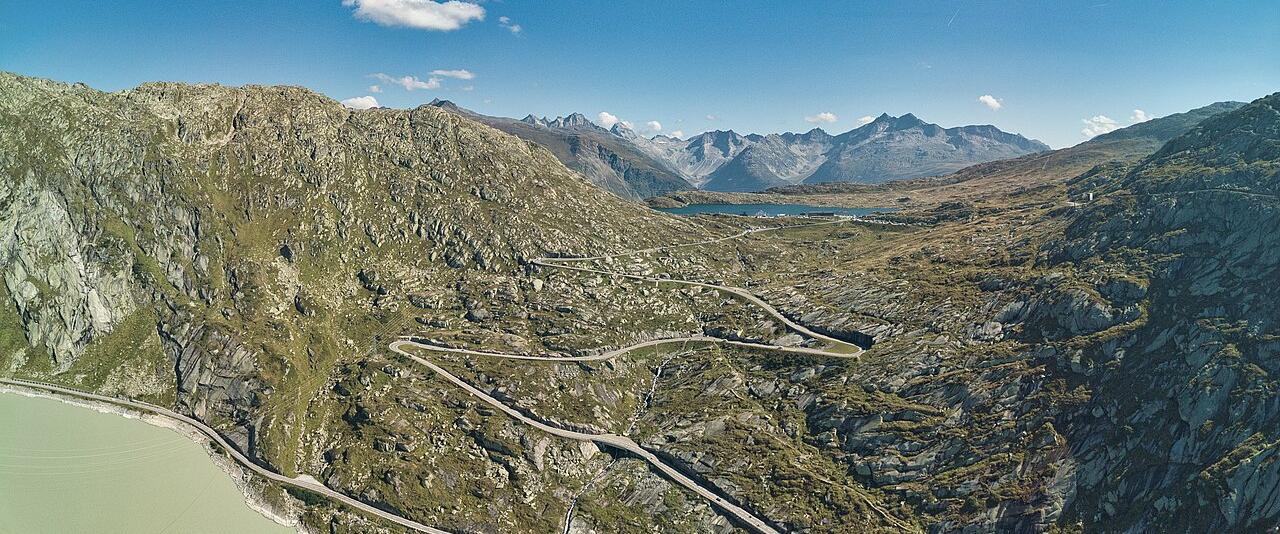
 The Grimsel Pass road, one of the Alpine passes that are easier to explore by car than by train. Image: Daniel Reust, CC BY-SA 4.0, via Wikimedia Commons.
Can I drive in Switzerland with a US or UK licence?
Yes. Under Swiss federal rules, visitors can drive on a valid national driving licence. The Swiss mission in Geneva says holders of licences in a language other than German, French, Italian or English need a valid international driving permit as well. If you can't show a permit, you need a translation of the licence made by an official body, such as the authority that issued it, a notary or an approved translator. Your first name and surname must appear in Roman script.
A US or UK licence is in English, so you don't legally need an international permit to drive in Switzerland. Some rental desks still ask for one, and you will need one if you drive on into a country that requires it. These rules are for visitors. Anyone who has lived in Switzerland for more than 12 months has to swap to a Swiss licence.
How old do you have to be to rent a car in Switzerland?
The law sets the minimum age for a driving licence. The rental company sets the minimum age for renting from it. Each company has its own minimum age and minimum years of driving experience. Many add a young-driver surcharge, and some limit younger drivers to smaller car classes. If you are under 25, compare the age terms as well as the price before you book. Expect to need a credit card in the main driver's name for the deposit.
Do you need a vignette to drive in Switzerland?
Yes, if you use the motorways, which is hard to avoid. The motorway vignette costs CHF 40 and covers a full calendar year plus two extra months: it is valid from 1 December of the previous year to 31 January of the following year. The 2026 vignette, for example, runs from 1 December 2025 to 31 January 2027. There is no short-term version.
It comes in two forms:
- E-vignette: bought online at e-vignette.ch, the federal Via portal, and linked to the car's number plate. All you need is the country of registration and the plate number. Buy it only there: the federal customs office (BAZG) says its price is CHF 40, and resellers may add fees.
- Sticker: linked to one vehicle and stuck on the windscreen. You can buy it at petrol stations, post offices and customs posts at the border. You can't move a used sticker to another car.
A car rented in Switzerland should already have a valid vignette. Check that it does, especially around the December–January changeover. A car rented on the French side of Geneva Airport, or anywhere else outside Switzerland, may not have one. Buy the e-vignette before you join a Swiss motorway, because the fine for driving without one is CHF 200, and you still have to buy the vignette.
 A Swiss motorway vignette sticker. The e-vignette, linked to the number plate, now does the same job. Image: FlippyFlink, CC BY 4.0, via Wikimedia Commons.
Renting from the French side of Geneva Airport
Geneva Airport sits on the French border and has a France Sector with its own car rental desks. The airport lists Avis, Budget, Enterprise, Europcar, Hertz and Sixt there. Renting on the French side can make sense if you are heading into France, for example to Chamonix or Annecy. Prices and the terms for taking the car across the border can differ from the Swiss side, so compare both.
The practical rules, from the airport: only passengers with a flight ticket for the same day (plus or minus one day) can walk between the Swiss and French sectors inside the terminal. Arriving passengers follow the "Destination France" signs after customs. Anyone else, including people renting a car without a flight, can reach the France Sector only by road, through the Ferney-Voltaire customs post. It is open to motor vehicles only; you can't walk or cycle it.
Before driving a French-registered car into Switzerland, check whether it has an e-vignette. Whatever the car, ask the rental company whether it allows cross-border trips and what it charges for them.
 The France Sector at Geneva Airport, with its own arrivals area and car rental desks. Image: Matti Blume, CC BY-SA 4.0, via Wikimedia Commons.
Are winter tyres compulsory in Switzerland?
No. The federal portal ch.ch says there is no legal obligation to fit winter tyres, but the driver must always stay in control of the vehicle. If you have an accident on a car that isn't properly equipped for winter, you can be held liable, and the insurer may not pay the full cost or may claim against you for negligence. The portal recommends winter tyres from October until Easter.
If you are booking for a ski trip, confirm that the car comes with winter tyres. On some mountain roads, a sign makes snow chains compulsory. If you plan to drive to a ski resort, ask whether chains are included or available, and practise fitting them before you need to.
Car trains through the Alps: Lötschberg, Furka and Vereina
Three railway tunnels carry cars through the mountains on shuttle trains. In winter they replace pass roads that close, and in summer they save a long drive. You stay in your car for the crossing. None of the three regular shuttles takes reservations: you buy a ticket and join the queue.
Lötschberg (BLS), Kandersteg–Goppenstein: links the Bernese Oberland with Valais. A car costs CHF 28 one way Monday to Thursday and CHF 31 Friday to Sunday and on public holidays, bought at the loading stations. A ticket doesn't guarantee a place on a particular train. BLS also runs the Simplon car train between Brig and Iselle in Italy (CHF 27 for a car).
 Kandersteg station, where cars load for the Lötschberg tunnel to Goppenstein. Image: JoachimKohler-HB, CC BY-SA 4.0, via Wikimedia Commons.
Furka (Matterhorn Gotthard Bahn), Realp–Oberwald: links Uri with the Goms valley in Valais all year, in under 20 minutes. The railway says this saves about 45 minutes compared with driving over the Furka Pass. Single tickets start at CHF 33, and are valid in either direction. You can't reserve a departure; if you enter your number plate when you buy online, the barrier opens automatically.
 Oberwald station in the Goms valley, the Valais end of the Furka car train. Image: NAC, CC BY-SA 4.0, via Wikimedia Commons.
Vereina (Rhaetian Railway), Klosters Selfranga–Sagliains: links the Prättigau with the Lower Engadine through the 19 km Vereina Tunnel in 18 minutes. Trains run every 30 minutes for most of the day. A car costs CHF 36 in summer (1 May to 30 November 2026). In winter (1 December 2026 to 30 April 2027) it costs CHF 41 at the terminal or CHF 39.50 online.
 The Vereina car train at Klosters Selfranga, the northern end of the tunnel to the Engadine. Image: Asurnipal, CC BY-SA 4.0, via Wikimedia Commons.
Speed limits and fines in Switzerland
The limits are 120 km/h on motorways, 100 km/h on expressways, 80 km/h on other roads outside built-up areas and 50 km/h in built-up areas, unless signs say otherwise. The penalties rise steeply:
- Small excesses get a fixed fine. The police deduct a tolerance from the measured speed first (3 km/h when a laser reads 87 km/h, for example).
- Larger excesses mean a court summons, and a fine of at least CHF 400, which goes up with your income for serious cases.
- You can lose your licence for a month or more at 21 km/h over in town, 26 km/h over outside towns and 31 km/h over on motorways.
- "Excessive speeding" (40 km/h over in town, 60 outside built-up areas, 80 on motorways) can bring one to four years in prison, a driving ban of at least two years and possible confiscation of the car.
The drink-driving limit is 0.05% blood alcohol. Between 0.05% and 0.079%, the federal portal lists a reprimand and a fine of around CHF 600 to 800. Drivers on a probationary licence have a limit of 0.01%, which in practice means none at all.
Parking: blue zones and the parking disc
Swiss towns use blue zones, marked with blue lines, where parking is free but time-limited, and you must show a parking disc (Parkscheibe, disque de stationnement) behind the windscreen. If your rental car doesn't have one, ask at the desk. Set it to the next mark after your arrival: if you arrive at 9:05, set it to 9:30.
In Zurich, for example, you can park in a blue zone for one hour between 8:00 and 11:30 and between 13:30 and 18:00, Monday to Saturday. If you arrive between 11:30 and 13:30, you can stay until 14:30, and if you arrive between 18:00 and 8:00, until 9:00. Sundays and public holidays are unlimited unless a sign says otherwise. Electronic discs are not allowed. Geneva's blue zones work the same way, with a one-hour limit Monday to Saturday from 8:00 to 11:30 and from 13:30 to 19:00.
 A blue parking disc. Set it to your arrival time and leave it behind the windscreen in blue zones. Image: Tschoggi, CC BY-SA 3.0, via Wikimedia Commons.
Tips for driving a rental car in Switzerland
- Check the vignette before you leave the rental car park, and buy an e-vignette yourself if the car is registered abroad.
- Book winter tyres for ski trips, and ask about snow chains for mountain resorts.
- Use car trains in winter when the high passes are closed, and allow time to queue on busy weekends.
- Keep a parking disc in the car and learn the blue-zone hours for the town you are in.
- Drive at or below the limit. Swiss fines start low but rise fast, and serious speeding is a criminal offence.
- Park and ride in cities. Zurich, Geneva, Basel and Bern have good public transport and expensive parking, so many visitors keep the car for the mountains and use trains and trams in town.