You don't strictly need Swiss francs for a short trip to Switzerland. Cards and contactless payment are accepted almost everywhere, and many shops, hotels, restaurants and the SBB ticket machines also take euros. But the currency is the Swiss franc (CHF), and when you pay in euros, your change comes back in francs at an exchange rate the seller chooses. The simplest approach for most visitors is to pay by card and carry a small amount of francs in cash for places that don't take cards, such as some mountain huts, farm stalls and honesty-box payments.
This guide covers where euros work, how to pay at the station, what to do about cash, tipping, and the two cases visitors often ask about: Geneva on the French border, and Liechtenstein.
Quick facts (checked October 2026)
- Currency: Swiss franc (CHF), divided into 100 centimes (Rappen in German). Switzerland is not in the EU and does not use the euro.
- Coins: 5, 10, 20 and 50 centimes; 1, 2 and 5 francs.
- Notes: 10, 20, 50, 100, 200 and 1,000 francs.
- Euros: accepted in many shops, hotels, restaurants and at SBB ticket machines (notes only), with change in francs.
- Cards: credit and debit cards accepted almost everywhere; Visa, Mastercard, American Express and Maestro are the most common.
- Tipping: not required; rounding up or about 10% is customary in many restaurants.
- Liechtenstein: uses the Swiss franc too.
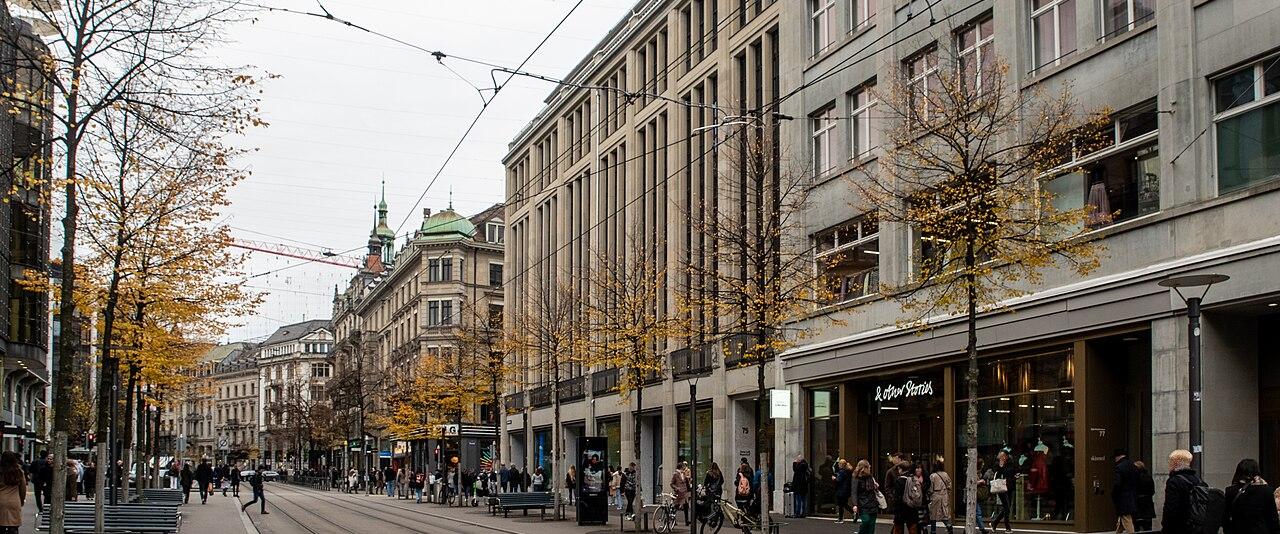
 Bahnhofstrasse in Zurich. Shops here, as almost everywhere in Switzerland, take cards. Image: Balise42, CC BY 4.0, via Wikimedia Commons.
Can you use euros in Switzerland?
Often, yes. Switzerland Tourism, the national tourist board, says that many places display prices in both euros and francs, and that it is very often possible to pay in euros, with change in Swiss francs. Major department stores, many shops, hotels, restaurants and souvenir shops generally take euros.
There are three catches:
- The seller sets the exchange rate. Each shop, restaurant or ticket office decides how many euros a franc costs, and that rate usually includes a margin. Paying in euros can cost noticeably more than paying the franc price by card.
- Change comes in francs. If you pay a CHF 12 bill with a €20 note, you get francs back, so you end up with Swiss cash anyway.
- Not everywhere takes euros. Small cafés, bakeries, kiosks, market stalls and mountain businesses may accept only francs or cards. Euro coins are often refused; SBB ticket machines, for example, take euro notes only.
So euros are a useful fallback, for example on your first day before you have francs. They are not the cheapest way to pay.
 The ninth series of Swiss banknotes, from 10 to 1,000 francs. Image: Allain22, Public domain, via Wikimedia Commons.
Can you pay with euros on Swiss trains?
At ticket machines, yes, with notes. SBB's payment page lists CHF coins, CHF notes and EUR notes as accepted at its ticket machines. All change is given in Swiss francs. Newer machines give change up to CHF 100 in notes and coins. Older machines give change only in coins, up to CHF 20. A single transaction can take no more than 35 coins and 15 notes.
The machines also take Maestro, V Pay, Visa, Mastercard, American Express, Diners and JCB cards, Apple Pay, Google Pay and Samsung Pay. The SBB Mobile app takes credit cards, some debit cards (Debit Mastercard and Visa Debit), Apple Pay and Google Pay, which is often the easiest option for visitors. In SBB restaurant cars and bistros you can pay in cash, by card or with TWINT, and euros are accepted, but within Switzerland your change is in francs.
If you are planning a lot of train travel, see our Swiss Travel Pass vs Half Fare Card comparison: buying a pass in advance means fewer payments at machines.
 SBB ticket machines at Zurich Airport station. They accept euro notes and give change in francs. Image: Mike Knell, CC BY-SA 2.0, via Wikimedia Commons.
Cards, contactless and TWINT
Switzerland Tourism says credit and debit cards are accepted almost everywhere. Contactless card and phone payments are normal in shops, restaurants, on public transport and at most hotels.
You will also see TWINT stickers at tills, on parking machines and at farm stalls. TWINT is the Swiss mobile payment app, and each account is linked to a mobile number and a bank account. It is widely used by Swiss residents and most Swiss banks take part. Most short-stay visitors won't have it. Where TWINT is the only cashless option, for example at an unstaffed farm stall or an honesty box, you need cash.
Choose francs on the card terminal. If a card machine or cash machine offers to charge you in your home currency instead of francs, decline and pay in CHF. The conversion offered at the till usually costs more than your own bank's.
Do you need cash in Switzerland?
A little, yes. Cards cover most spending in towns, but some situations still call for cash:
- Mountain huts. Some staffed huts take cards. The Swiss Alpine Club's route portal lists card payment for some huts (the Kesch hut in Graubünden, for example) but not for all, so check the hut's page and bring enough francs for half board and drinks. At unstaffed huts, the club's terms say you pay in cash into the hut's cash box, or by bank transfer afterwards.
- Farm stalls and honesty boxes, selling cheese, eggs or fruit by the road.
- Small mountain restaurants, kiosks and markets, especially off-season.
- Small tips, if you want to round up in cash.
ATMs are at stations, airports and bank branches, and they dispense francs. You can also change money at banks, exchange offices, the airport, major hotels and SBB stations. SBB Change counters operate at around 150 SBB sales points and charge a flat CHF 5 fee per purchase, whatever the amount. The counters take cash and debit cards, but not credit cards. They will also buy back unused foreign currency.
 Swiss coins, from the 5-franc piece down. Image: Exploratorium efimeros, CC BY-SA 4.0, via Wikimedia Commons.
Do you tip in Switzerland?
You don't have to. Switzerland Tourism says guests are not obliged to tip, but that in many restaurants it is customary: about 10 percent, or rounding up to a round amount. In practice, most people round up the bill at a café (a CHF 4.60 coffee becomes CHF 5) and add a little more after a good restaurant meal. When paying by card, tell the server the total you want to pay before they enter the amount.
Geneva: francs or euros?
Geneva is a Swiss city and uses the Swiss franc, even though it is almost surrounded by France and many people commute across the border every day. Euros are widely accepted in the city, as elsewhere in Switzerland, with change in francs. If you are staying in Geneva and making day trips into France (to Annecy or Chamonix, for example), you will need both currencies, or a card for each side of the border.
Geneva Airport has a French sector as well as the main Swiss one, and you can rent a car on the French side. Our guide to renting a car in Switzerland explains how it works.
 Rue du Rhône in Geneva. The city is almost surrounded by France but uses the Swiss franc. Image: MHM55, CC BY-SA 4.0, via Wikimedia Commons.
Liechtenstein uses the Swiss franc
If you take a day trip to Vaduz, you won't need a different currency. Liechtenstein has used the Swiss franc as its official currency since 1924, and the principality's official website says euros are also accepted. Swiss cards and Swiss cash work exactly as they do in Switzerland.
 The Städtle, the main pedestrian street in Vaduz, Liechtenstein, where prices are in Swiss francs. Image: Cbliu, CC BY-SA 4.0, via Wikimedia Commons.
Money tips for Switzerland
- Pay by card in francs wherever you can. It is usually cheaper than paying in euros or letting the terminal convert.
- Withdraw a small amount of cash on arrival, enough for a hut stay, a farm stall or a small café.
- Use euro notes at SBB machines in a pinch, but expect your change in francs.
- Don't rely on euro coins. They are often refused.
- Check hut payment options before you hike, and carry enough cash in case the card machine is down.
- Spend your coins before you leave, or change leftover notes back at an SBB Change counter.
 The Brunnihütte, a Swiss Alpine Club hut. Check whether a hut takes cards before you go. Image: W. Bulach, CC BY-SA 4.0, via Wikimedia Commons.