Larches in the Jungfrau Region: What to Expect
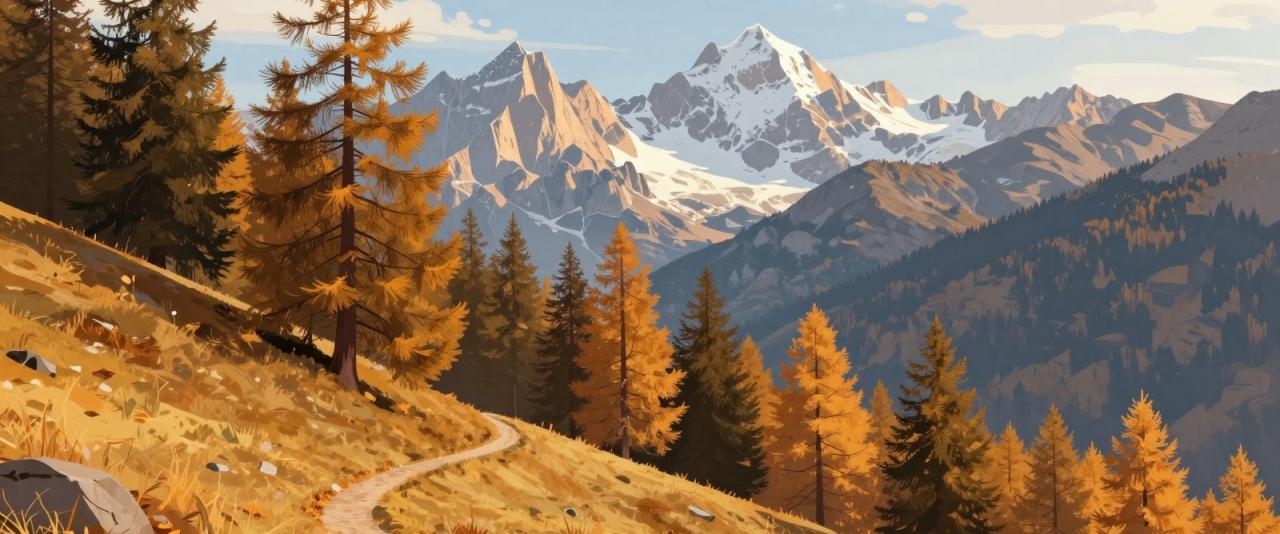
The European larch is one of the few conifers that loses its needles in winter, and before it does, they turn yellow and then deep gold. In the Alps this happens between about mid-October and early November, depending on altitude and the weather that year.
It is worth being clear about the Jungfrau Region. Its mountain forests are mostly spruce, with larches mixed in, particularly on sunny slopes and toward the tree line. You will see golden larches scattered through the forest above the Lauterbrunnen Valley and around Mürren and Wengen, but not the solid golden hillsides of Valais or the Engadin. What you get instead is a combination of gold and dark green trees, fresh snow on the Eiger, Mönch and Jungfrau, and quiet trails after the summer crowds have left.
Timing and Lift Closures
Timing is the main challenge in autumn here. Trees around Mürren usually start to colour in the first half of October, while the best larch colour tends to come in the second half of the month. That overlaps with the autumn maintenance season, when many lifts close:
- In 2026, the Allmendhubel funicular in Mürren closed from 19 October, and the Stechelberg-Gimmelwald-Mürren cableway closed from 19 to 30 October.
- The Grindelwald-First gondola, Männlichen cableways and the Lauterbrunnen-Grütschalp cable car closed from 26 October, and the Schynige Platte railway ended its season on 25 October.
- The Schilthorn cableway from Mürren upward runs year-round apart from short breaks.
Dates change each year, so check the Jungfrau Railways and Schilthorn websites before you go. If you can, aim for the middle two weeks of October, when colours are starting to show and most lifts still run.
Grütschalp to Mürren
The cable car from Lauterbrunnen to Grütschalp gives access to one of the region's easiest autumn walks. The path to Mürren follows the hillside on a near-level route, about 4.5 km and roughly an hour and a half, with mixed conifer forest on one side and the Eiger, Mönch and Jungfrau across the valley. In mid-October the forest edges show golden larches against the darker spruces. Finish in car-free Mürren, which has cafés and hotels open through much of October.
Walks from Mürren
Mürren to Gimmelwald and Stechelberg
From Mürren, a paved path drops in about 45 minutes to Gimmelwald, a farming hamlet on a ledge above the valley. Fit walkers can continue downhill through the forest toward Stechelberg on the valley floor, which takes roughly another hour and a half on a steep path. This descent passes through mixed woodland where the yellow of larches and deciduous trees is at its best in October. From Stechelberg, buses run back to Lauterbrunnen. If the Gimmelwald cableway is closed for maintenance, walking is the way to go anyway.
The Northface Trail
If the Allmendhubel funicular is still running, the Northface Trail from Allmendhubel back to Mürren is a fine choice, about 6.5 km and two hours, mostly downhill, with boards explaining the history of climbing on the north faces opposite. The higher sections cross open pasture with views over the whole valley, and the lower part runs back through forest. Once the funicular closes, you can walk up from Mürren instead.
Schynige Platte and Lake Brienz
Until the railway closes in late October, the Schynige Platte panorama loop gives views of the Jungfrau peaks on one side and Lake Brienz on the other. It takes about two hours. The slopes below the ridge mix conifers and broadleaf trees, and the old cog railway from Wilderswil climbs through them on the way up.
For Denser Larch Forests: Oeschinensee and Beyond
If golden larch forests are the main goal, consider a day trip to Oeschinensee above Kandersteg, about an hour from Interlaken by train via Spiez. The lake is one of the few places in the Bernese Oberland with a small golden larch forest, and its gondola usually runs into late autumn. For larch forests on a larger scale, the valleys of Valais and the Engadin in Graubünden are Switzerland's best-known areas.
Practical Tips
- Days are short. Start by mid-morning and plan to finish before about 17:00. Deep valleys such as Lauterbrunnen lose direct sun early in the afternoon.
- Expect frost and early snow. Paths above about 1,800 metres can be icy in the morning or covered by early snowfall. Wear proper hiking boots.
- Pack layers. Mornings can be near freezing even when afternoons are mild. Bring a warm layer, a waterproof jacket, gloves and a hat.
- Check what is open. Many mountain restaurants and some hotels close between the summer and winter seasons, so carry water and food.
With flexible dates and an eye on the lift timetables, October is one of the most peaceful months to walk in the Jungfrau Region.