







- Where
- Saint-Ursanne, Jura
- Directions
- Directions
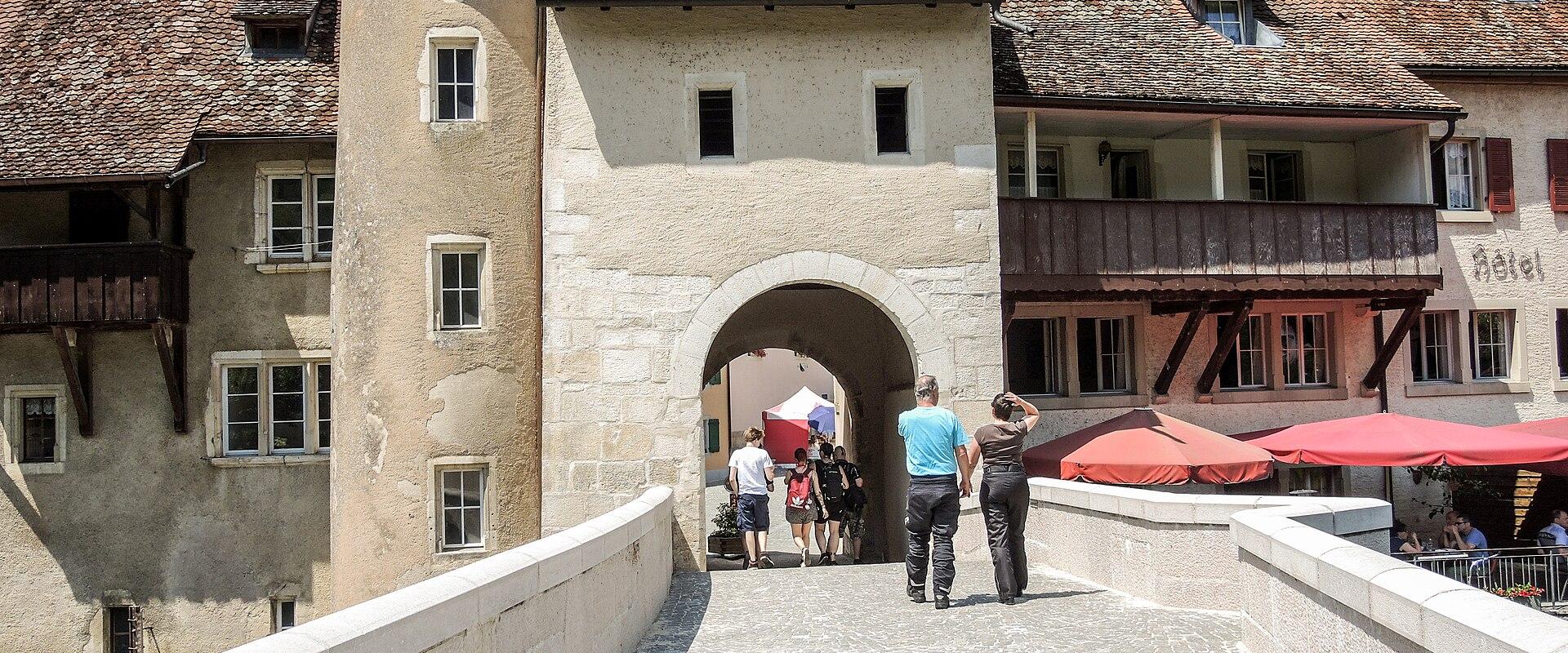
Saint-Ursanne is a small medieval town in the canton of Jura, tucked into a bend of the Doubs river at the foot of steep, wooded cliffs, and the stone bridge that crosses the river at the edge of the old town is one of its best-known sights. The bridge is called the Pont Saint-Jean, and it is a stone structure of several arches that spans the Doubs and leads to the town gate. It dates from the early eighteenth century, in its present form, and it replaced earlier crossings that go back to the Middle Ages. Standing at the midpoint of the bridge, you see the town rising on the far bank: the roofs of the old houses, the towers of the collegiate church and, behind, the rocky slopes of the Jura.
A statue stands on the bridge, a figure of Saint John of Nepomuk, a Bohemian priest who was drowned in the Vltava in Prague in the fourteenth century and was venerated as a protector of bridges and travellers, and as a patron against floods. Statues of this saint are found on bridges across central Europe, especially in regions that were influenced by the Baroque Catholic culture of the Habsburg lands, and the figure here reflects that tradition. The statue is also the reason for the bridge's name. Its presence gives the crossing a spiritual dimension and a photogenic quality, and many visitors stop to look at it and the view of the river.
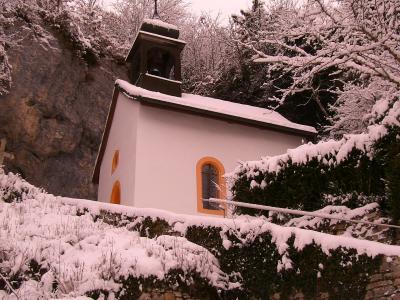
The town beyond the bridge takes its name from a saint of another kind. Ursicinus, in French Ursanne, was an Irish or Frankish monk, a follower of the missionary Columbanus, who is said to have settled as a hermit in the valley of the Doubs in the seventh century. A monastery grew up around his cell, and the town developed from it. A small chapel on a rock above the river, the Chapel of the Hermitage, is traditionally linked to his retreat and can be reached by a walk from the town. The collegiate church, built in the twelfth and thirteenth centuries, has a fine Romanesque portal and a cloister, and it stands at the centre of the old town, with its massive towers and a roof of coloured tiles.
The old town is entered by a gate, the Porte Saint-Jean, at the end of the bridge, and within the walls there are narrow streets, arcades, fountains and houses of the sixteenth to eighteenth centuries, often with painted shutters and flower boxes. The quiet atmosphere and the position by the river have made the town a favourite with day-trippers and with walkers on the long-distance paths of the Jura. The Doubs itself is a calm, green river here, used for canoeing and fishing, and a trail runs along its banks. The town also hosts open-air events and exhibitions in summer, including sculptures placed in the old town.
The bridge is free to cross and open at all times. It is a short walk from the railway station, on a line from Delémont and Porrentruy, and parking is available outside the walls. The site suits walkers, photographers, history readers and families. Allow thirty to sixty minutes for the bridge and the old town, and two to three hours if you include the church and the hermitage chapel. Wear comfortable shoes, since cobbles are uneven.
Categories
More photos coming soon
Nearby Attractions
Other places to visit in Saint-Ursanne
Questions people ask
Quick Facts
Best Time to Visit
June to September offers warm weather, lively festivals, and ideal conditions for exploring Saint-Ursanne’s medieval town and Doubs valley.