Planning the Walk
Lucerne's Old Town is compact and almost entirely walkable from the railway station. A loop taking in both wooden bridges, the main squares, the Musegg Wall and the Lion Monument covers around 4 km and takes half a day at an easy pace with stops. The route below starts at the station and finishes near the lakefront.
Chapel Bridge and the Water Tower
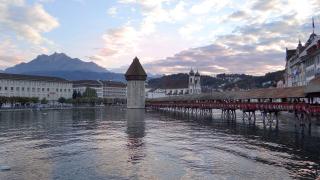
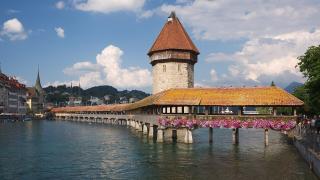
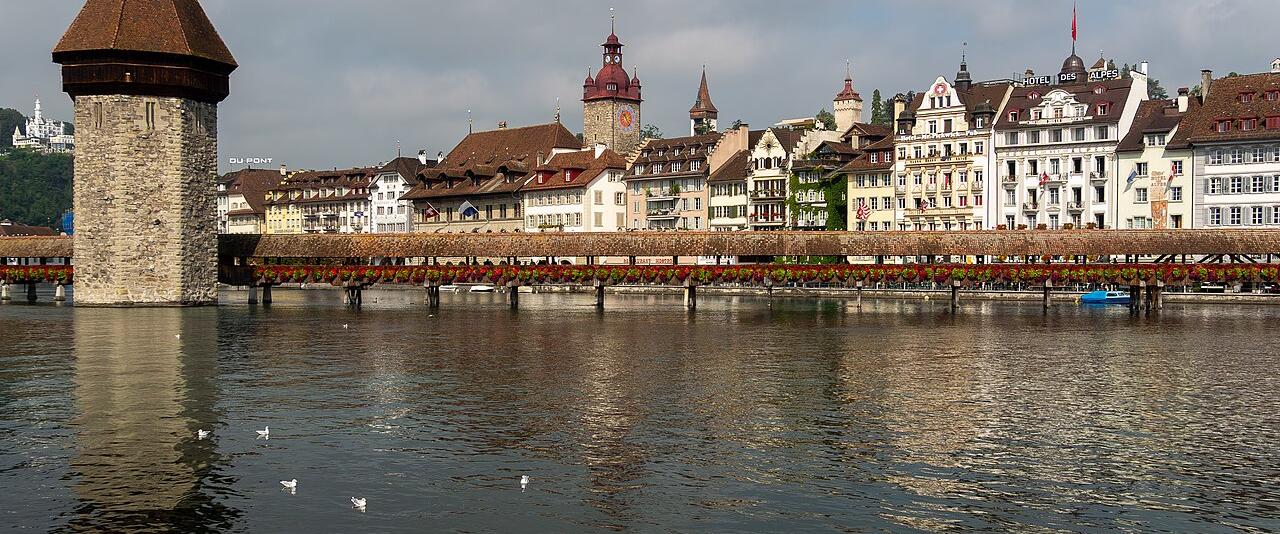
Start with the Kapellbrücke (Chapel Bridge), the covered wooden footbridge that crosses the Reuss diagonally just a few minutes from the station. It was built in the 14th century as part of the town's fortifications and is now about 205 m long, shorter than its original length of more than 270 m.
Inside the roof are triangular paintings by Hans Heinrich Wägmann from the 17th century showing scenes from Lucerne's history. A fire on 18 August 1993 almost destroyed the bridge and two-thirds of the paintings. It was rebuilt and reopened in April 1994, and you can still see charred panels among the restored ones. The octagonal Water Tower beside it is older than the bridge and has served as a prison, archive and treasury. It is not open to visitors.
The Squares of the Right Bank
Cross to the right bank and wander into the lanes behind the river. The Kornmarkt is dominated by the Old Town Hall, built in the early 17th century in Renaissance style. A few steps away, the Weinmarkt is lined with houses with painted façades and has a fountain at its centre. The Hirschenplatz and its surrounding streets also have decorated house fronts.
Along the river, the arcades of the Rathausquai are busy with cafés, and the Saturday morning market sets up along the Reuss.
Spreuer Bridge
Follow the river downstream to the Spreuerbrücke, the second surviving covered wooden bridge. It was completed around 1408, and under its roof hangs a cycle of Dance of Death paintings made between 1616 and 1637 under the direction of Kaspar Meglinger. Of the original 67 panels, 45 survive. It is quieter than the Chapel Bridge and gives a good view of the weir (Nadelwehr) that regulates the lake level.
On the left bank between the two bridges, the Jesuit Church stands right on the riverfront. Built in the second half of the 17th century, it was one of the first large Baroque churches in Switzerland, and its white and pink interior is a contrast to the dark timber of the bridges. Entry is free outside services, and it makes a good stop if the weather turns.
The Musegg Wall
From the northern end of the Old Town, climb to the Musegg Wall, the best-preserved section of Lucerne's medieval fortifications, with nine towers running along a ridge above the town. Several towers, including the Zyt tower, can usually be climbed in the warmer months, and the wall walk gives views over the rooftops, the river and the lake. The Zyt tower clock is traditionally allowed to strike one minute before all the other clocks in the city. The towers are closed in winter, so check opening dates if you are visiting outside the main season.
The Lion Monument and the Lakefront
Walk down from the wall to the Lion Monument (Löwendenkmal), a dying lion carved into the rock face in 1820–21 from a design by Bertel Thorvaldsen. It commemorates the Swiss Guards who died in Paris in 1792 when the Tuileries Palace was stormed. Mark Twain called it "the most mournful and moving piece of stone in the world". Entry is free.
From there it is a short walk to the Hofkirche with its twin towers and then down to the lakefront promenade (Schweizerhofquai), which leads back towards the Chapel Bridge.
Practical Tips
- Go early in the morning to see the Chapel Bridge before tour groups arrive.
- Wear comfortable shoes: the lanes are cobbled and the climb to the Musegg Wall is steep.
- In winter, when the Musegg towers are closed, shorten the loop to the bridges, the squares and the Lion Monument.
- During Lucerne Fasnacht (carnival) in February or March the Old Town is packed and noisy for several days. Check the dates if you want either to join in or to avoid it.
- The Old Town has many public fountains with drinking water, so a refillable bottle is enough on a warm day.